

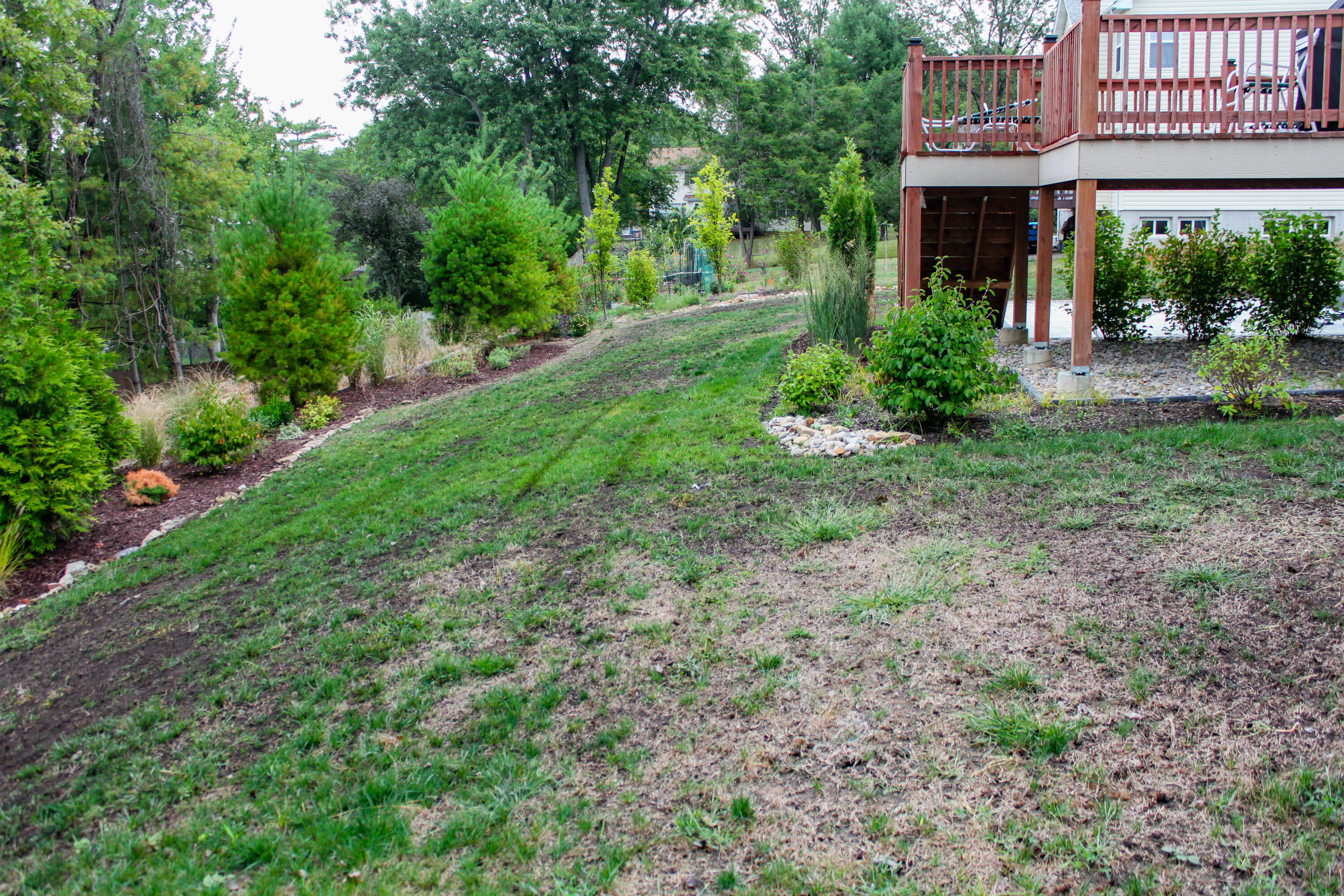
Before Undergoing Our Lawn Restoration – a St. Louis Lawn
You watered it. You mowed it. You did everything right in April, and it looked incredible in May.
Now it’s August and there are tan patches spreading across the front yard, the grass by the back door has given up entirely, and the whole thing feels crunchy underfoot. You are not imagining it, and you did not do anything wrong.
This is the hardest month of the year to be a lawn in St. Louis. Here’s what’s actually happening out there, and why the six weeks that start in September matter more than the previous eleven months combined.
Why August is brutal on St. Louis lawns
St. Louis sits in what turf people call the transition zone. It’s too hot here for cool-season grasses to be comfortable and too cold for warm-season grasses to thrive. Most lawns in the area are tall fescue, which is a cool-season grass doing its best in a climate that does not love it.
Fescue wants 60 to 75 degree days. In August we hand it 95 degrees, 70 percent humidity, warm nights that never let the lawn cool down, and a canopy that stays damp from dusk until mid-morning.
That combination does two things at once. It stresses the grass to the edge of survival, and it creates ideal conditions for fungal disease. One makes the other worse.
Lawn fungus in St. Louis: what you’re looking at
Fungal spores live in your soil year round. They are always there. They only become a problem when conditions line up, and August lines them up perfectly.
Here are the four that show up most in the St. Louis area.
Brown patch
This is the big one for fescue lawns, and it’s what most people are seeing when they call us in August. It shows up as roughly circular tan or straw-colored patches, anywhere from a few inches to several feet across. Early in the morning you may see a dark gray or purplish ring at the edge of the patch, sometimes with a faint webbing look across the blades.
Brown patch turns on when nighttime temperatures stay above about 68 degrees and the leaf blades stay wet for long stretches. In St. Louis that is most of July and August. Nitrogen-heavy fertilizer in early summer makes it worse, because lush new growth is exactly what the fungus wants.
Dollar spot
Smaller and tidier. Silver dollar sized bleached spots that can merge into larger blotchy areas. Look closely at an individual blade and you’ll often see a tan lesion with a distinct reddish-brown border across the middle of the leaf.
Dollar spot tends to show up on lawns that are underfed, especially where nitrogen has run out by mid-summer, and where heavy dew sits every morning.
Gray leaf spot
Mostly a problem for perennial ryegrass, which shows up in a lot of seed blends. Blades develop small oval lesions with gray centers, and badly hit areas can look scorched or greasy. Hot, wet, humid stretches drive it.
Pythium blight
Less common but fast and ugly. Dark, water-soaked streaks that follow drainage patterns or mower paths, sometimes with a cottony gray film early in the morning. It moves in low spots and poorly drained areas after heavy rain. If you’re seeing this one, time matters.
Why a fungicide alone usually disappoints people
Fungicide has a real place. It protects healthy turf and stops disease from spreading.
What it cannot do is bring back grass plants that are already dead. Once brown patch has killed a section of fescue, that section is gone, and you just have to wait for the grass to grow for it to look nice again.
Spraying it does nothing for the tissue that has already collapsed, which is why homeowners often spray in August, feel like it did not work, and stay frustrated through September.
Dead turf does not recover. It gets replaced. The question is how, and when.
The other half of the problem: your turf is just worn out
Fungus gets the blame because it’s visible, but it usually lands on a lawn that was already struggling.
Think about what your yard has been through since May. Kids and dogs running the same path to the gate. A grill and patio furniture parked in one spot. Weekly mowing on soil that has been baked hard. Foot traffic across the same route to the pool or the shed, over and over.
All of that compacts the soil. Compacted soil means roots cannot spread, water runs off instead of soaking in, and air and nutrients never reach the root zone. At the same time, a layer of thatch builds up between the green blades and the soil, and it acts like a sponge that holds moisture right where fungus wants it.
So by August you have shallow roots, hard soil, a damp thatch layer, heat stress, and disease pressure all sitting on the same lawn. Thin turf then opens the door for crabgrass and nutsedge, which are happy to fill the gaps.
Thin, patchy, tired turf in late summer is not a fertilizer problem. It’s a soil and structure problem.
The six week window that changes everything
Here’s the part most homeowners never hear.
For about six weeks out of the entire year, from the start of September until roughly October 15, St. Louis gives us a set of conditions you cannot buy or fake. Soil is still warm enough for grass seed to germinate quickly. Air temperatures are easing off. Fall rain patterns are arriving. And weed pressure is dropping off.
There’s a hard stop on the back end. Everything has to be finished before mid-October, because new grass needs warm soil and active growing time to root before the ground turns cold. Seed that goes down after that sits there. It does not establish, and winter takes it.
Cool-season grass seed planted in this window establishes faster and stronger than at any other time of year, including spring. Seed you put down in April is fighting crabgrass and racing an oncoming summer. Seed you put down now gets a long, mild fall to root deeply before winter, and it wakes up in spring already established.
That’s the whole idea behind our lawn restoration package. We are not fighting the weather. We are working with the best six weeks the calendar gives us, and there is no second chance at them until next year.
What lawn restoration actually looks like
This is the process, start to finish.
1. Pre-spray for weed control. Two weeks before the main work, we treat the lawn to clear out weeds so new seed is not competing for space, light, or nutrients from day one.
2. Dethatch, if needed. Not every lawn needs it. Where thatch has built up, we remove that layer of dead grass and debris so air, water, and seed can reach the soil instead of sitting on top of it.
3. Aerate and seed. We pull cores from the soil to relieve compaction, then seed directly into those openings. Seed that falls into an aeration hole makes real soil contact, which is the single biggest factor in whether it germinates. Seed scattered on hard ground mostly feeds birds.
4. Topdress. A nutrient-rich layer goes over the top. It enriches the soil, protects the seed, holds moisture at the surface where germination happens, and improves drainage over time.
5. Irrigation adjustments. New seed has completely different watering needs than established turf. We check your system, adjust coverage and timing, and make sure the water is actually landing where the seed is.
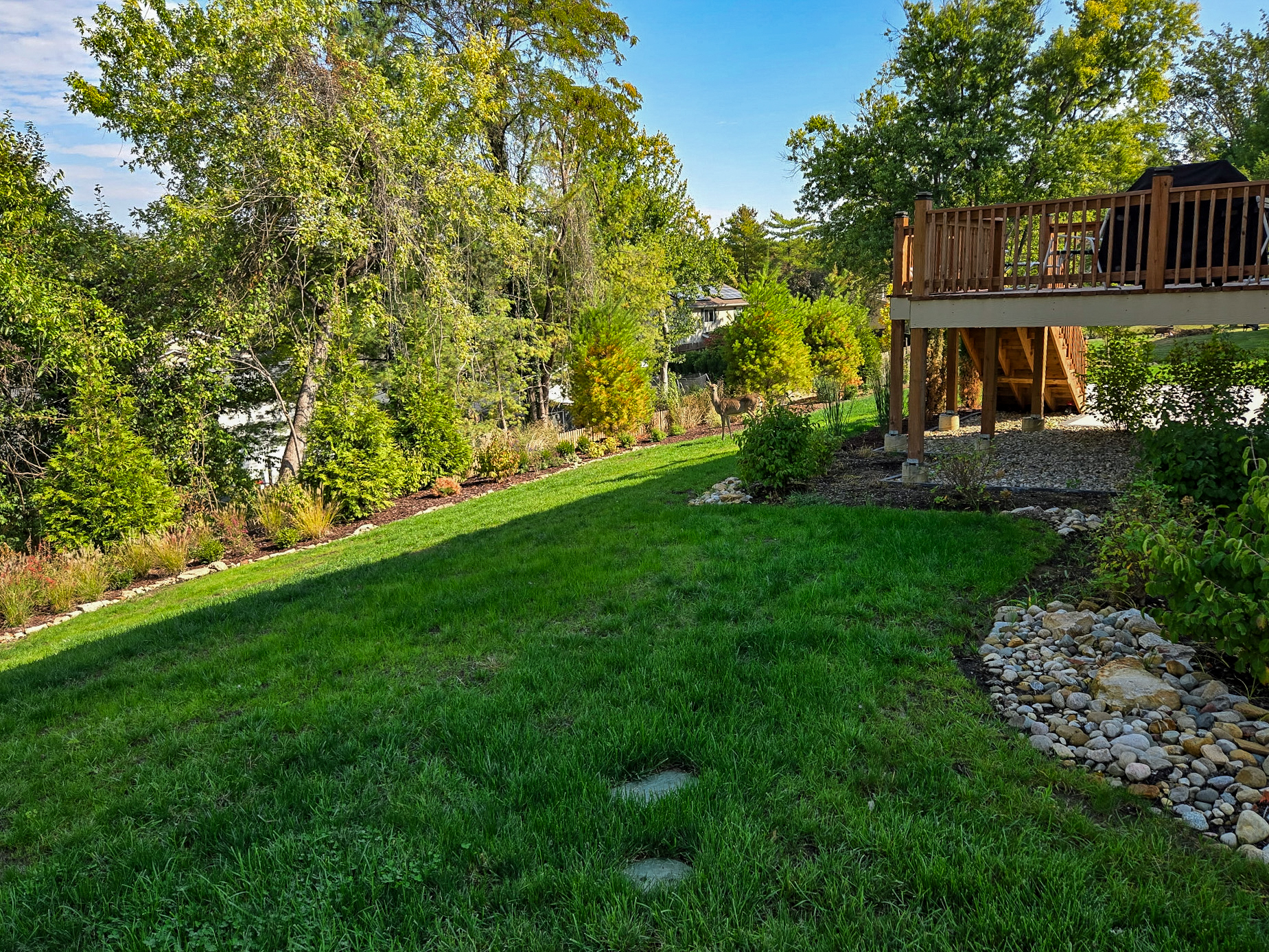
After Undergoing Our Lawn Restoration – a St. Louis Lawn
Already have a lawn care provider? Add topdressing.
Plenty of people we talk to are already on a program with someone, and they don’t need us to take over their lawn care. That’s fine. You can add topdressing on its own.
Topdressing is the step that does the visible work. It’s a nutrient-rich layer spread across the surface, and it feeds the soil directly instead of feeding the blades. What comes back is a deep, bright green that fertilizer alone does not produce, along with better drainage and a softer surface underfoot. If you have ever wondered why some lawns have a color yours does not, this is usually the difference.
It layers on top of whatever program you’re already running. Same window applies, September through October 15.
Why this beats the alternatives
Compared to resodding: sod is expensive, and it’s a transplant. It has to knit into soil that has not been corrected, which means the same compaction and drainage issues are waiting underneath. Restoration costs a fraction of sod and fixes the soil at the same time.
Compared to a year-long lawn care program: those programs work, and they are the right call for a lawn that’s fundamentally healthy. But if your turf is thin and worn out, a program is a slow rebuild measured in seasons. Restoration takes the shortcut nature offers once a year.
What you get is a lawn that comes in thick, deep green, and soft enough that you notice it barefoot. It looks new because it is new.
Common questions
Can I just wait until spring? You can, but spring seeding competes with crabgrass and gives new grass only a few weeks of root growth before summer heat arrives. Fall-seeded lawns spend the whole cool season building roots and come out of winter stronger.
What happens if we miss October 15? The work waits until next fall. Seed put down late does not have enough warm soil left to establish, so it’s money spent on grass that will not survive the winter.
Will the fungus come back next year? Disease pressure is a fact of St. Louis summers. But turf with deep roots, uncompacted soil, and good airflow handles it far better than thin, stressed grass does.
How long until it looks green? Germination typically starts within a couple of weeks in this window, with real fill-in through fall.
What if I don’t have an irrigation system? We’ll walk you through a hand-watering schedule that works.
The window opens in September, which means booking happens now
The scheduling math is tighter than it looks. The pre-spray goes down two weeks ahead of the main work, so a lawn getting restored the first week of September needs that treatment in late August. And because everything has to wrap before mid-October, there are only so many properties that fit in the window.
If your lawn looks rough and you’re not sure whether you’re dealing with fungus, compaction, or both, that’s exactly what a lawn assessment is for. We’ll walk the property, tell you what’s actually happening out there, and let you know whether restoration is the right call this year.
